
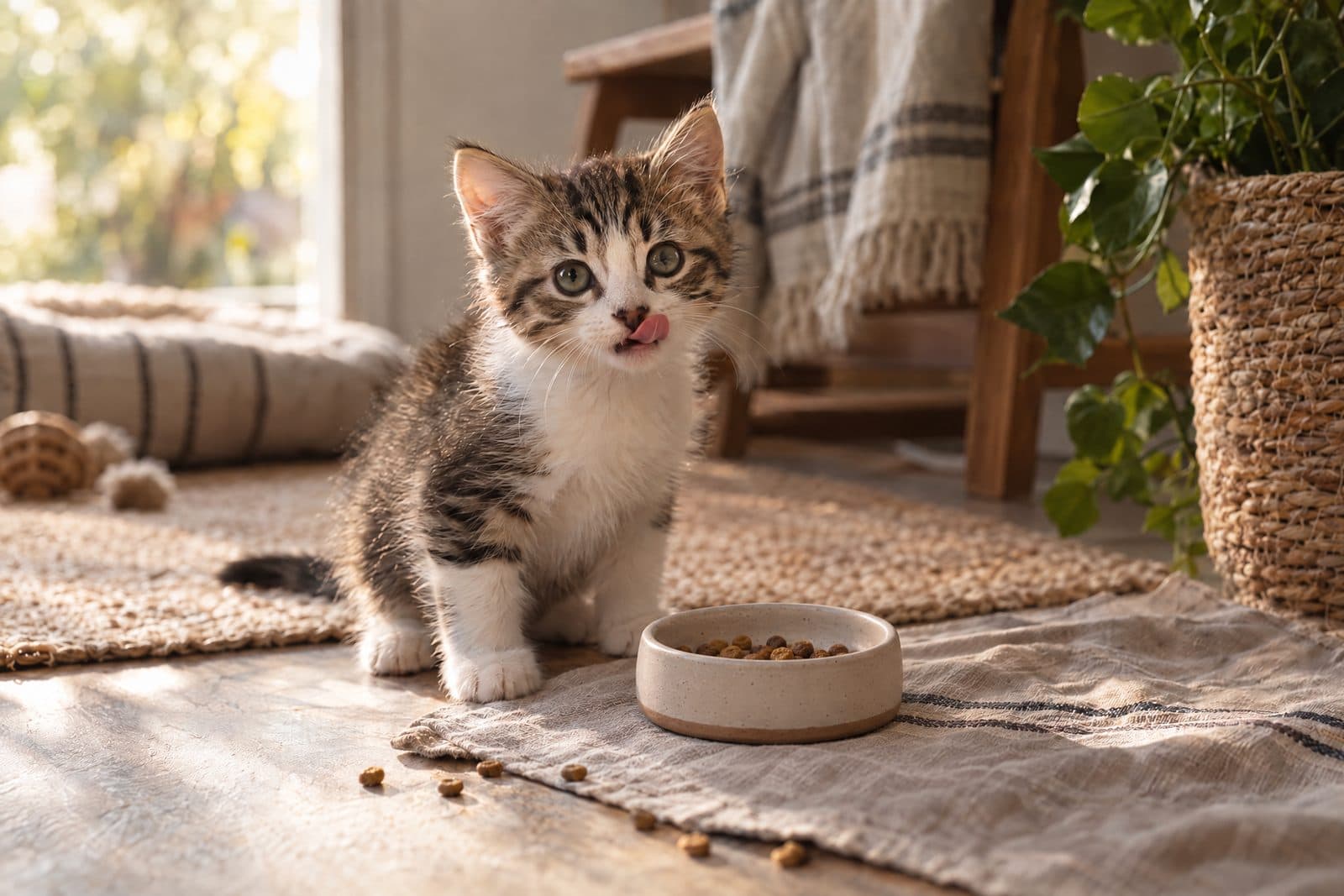
Your kitten eats as if the day is too short. One week the portion seems right, the next he is back at the bowl, meowing. And everything you read says something different: twice a day, four times a day, kitten food until twelve months, or adult food the moment he is neutered.
The confusion is understandable, because the honest answer is: it depends on his age, his weight and how fast he is growing. This article sets out exactly how much kitten food to give, how often, and when to move him onto food for adult cats. (Want the same logic for puppies? See puppy food: how much and when.)
Why kitten food is not a smaller portion of adult food
Kitten food is a complete diet formulated for the growth stage: more energy and building blocks per kilogram of body weight than maintenance food, with a composition suited to a cat that is still growing.
A kitten is building bone, muscle and organs all at the same time. That is why the requirement per kilogram of body weight is higher than for an adult cat. FEDIAF describes growing cats as having different energy and nutrient needs from adult animals at maintenance. [1] WALTHAM and similar nutrition sources make the same point: the kitten stage calls for a recipe formulated for it, not a scaled-down adult portion. [2]
The difference is not only in quantity, but in how the diet fits together. Cats are obligate carnivores: they need taurine, among other things, an amino acid that complete cat food includes as standard. [1] That is a modest nutritional baseline, not a medical promise. Switching to adult food too early can withhold nutrients and energy that a growing kitten still needs in that stage.
Later, after the growth stage, do you want to know what indoor living or neutering means for the portion? The knowledge bank on indoor and sterilized cats explains that separately.
How much kitten food per day?
Always start with the feeding table for the recipe you are feeding: it is the only table drawn up specifically for that food. [6] Then use your kitten's current weight, not the weight you hope he will reach.
Our own guidelines for Kitten Formula look like this (grams per day, split across three meals):
| Kitten weight | Kitten Formula (g/day) |
|---|---|
| 0.5 kg | 30 g |
| 1 kg | 45 g |
| 2 kg | 75 g |
| 3 kg | 95 g |
| 4 kg | 110 g |
These are internal reference values. The table on the packaging or product page remains the one to follow: recipes can change. [6]
This article is about dry food (kibble). Wet food or a mix can be counted in the daily total, but include the energy of both so you do not quietly feed too much.
In practice:
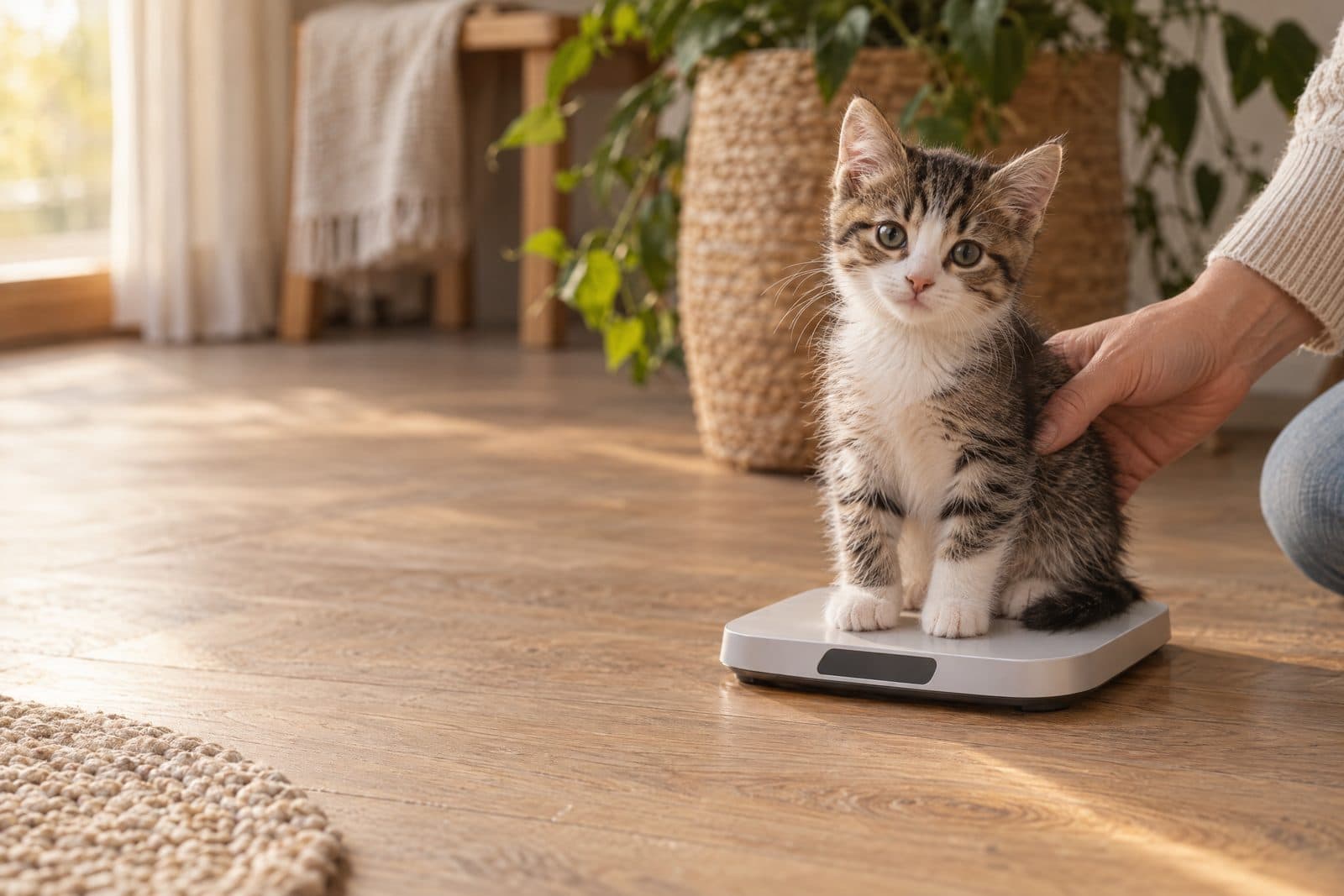
- Weigh your kitten. Preferably regularly in the first months, so the portion grows with his actual weight.
- Keep him in a healthy, lean condition. You should still be able to feel the ribs under a thin layer; an overweight kitten is not a healthier kitten. [1][2][3]
- Count everything. Treats, snacks and extras belong in the daily total.
- Adjust to what you see, not to a fixed formula. Energy needs differ between individuals, even between littermates.
Do not add extra vitamins, minerals or taurine on top of a complete kitten food, unless your vet advises it. Extra supplements are usually unnecessary and can upset the balance. [1]
How often per day?
The feeding schedule can grow with your kitten. There is no rule that fits every cat, but there is a practical sequence:
- Young kittens (up to about 4 to 6 months): several small meals a day, often three to four.
- After that, until the end of the growth stage: often three meals a day (as in our Kitten Formula guideline). [6]
- Towards adulthood: gradually back to two meals a day, if your kitten takes that calmly.
Some kittens may have a little kibble "ad libitum" (freely available) between meals, but then watch weight and condition extra carefully. If you are unsure about appetite, vomiting or weight gain that is too fast, ask your vet.
When do you switch to food for adult cats?
The turning point is the end of the growth stage: the point at which your cat has finished growing. For most household cats that is around twelve months. Large breeds often keep growing for longer.
For a typical household cat, around 12 months is a common moment to look from kitten food to adult food. [4][5] Most household cats around 12 months; large, late-maturing breeds such as Maine Coon often longer. Brand guidelines mention about 15 months, veterinary sources sometimes up to about 18 months. Skeletal maturity, body condition and your vet remain the guide. [3][4]
Switching too early can withhold energy and building blocks from a growing kitten. Switching too late, once he is fully grown and moving less, can lead to a too-generous energy intake. Adjust for condition: ribs palpable, waist visible from above.
Neutering or spaying is not a signal to switch straight to adult food. Your kitten still needs kitten food for the rest of the growth stage. Only once growth is complete do you look at adult or indoor food. After neutering, energy needs can fall later; that is a reason to watch portions, not to stop growth food early. [3][5][7]
Is your kitten growing unevenly, eating poorly, or are you unsure about weight and condition? Have your vet assess that.
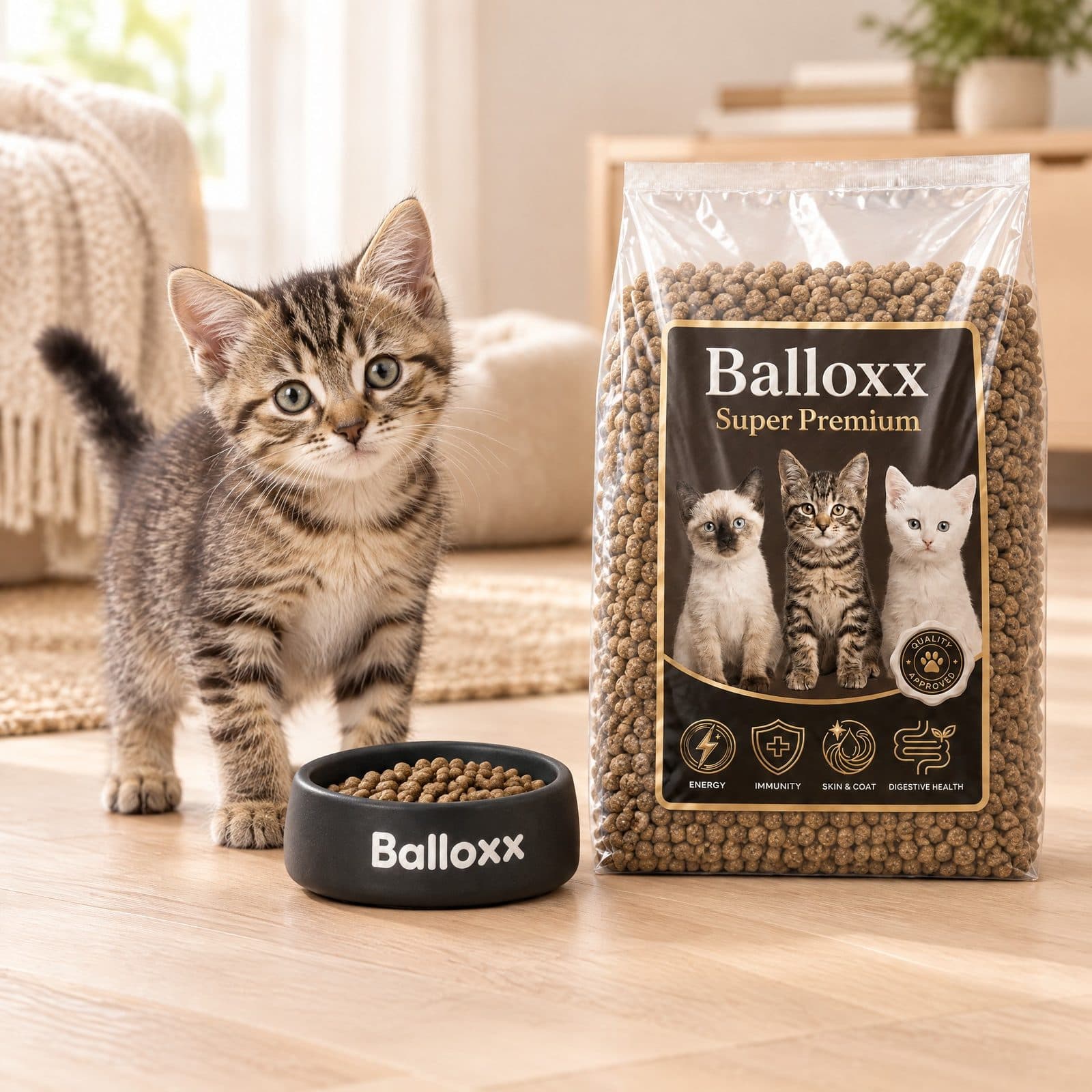
Which Balloxx recipe fits your kitten?
Kitten Formula
A complete dry food for kittens, with a feeding table by weight. An energy-dense composition for the growth stage. [6]
Once the growth stage is over:
Adult Cat Formula
For adult cats without a specific indoor focus.
Adult Cat Indoor
For cats that mainly live indoors (often also neutered). More in the knowledge bank on indoor and sterilized cats. [7]
Have you just switched to a new food? Follow the 7-day transition plan. [7]
See also the full kitten food range.
Frequently asked questions
How much kitten food per day?+
How often should a kitten eat?+
When can my kitten move to adult food?+
Can I switch to adult food straight after neutering?+
Can I add wet food to the kibble?+
The right start for your kitten
Browse the kitten range with a feeding table for each recipe, or compare Kitten Formula with adult and indoor recipes once the growth stage is over.
View kitten foodSources:
[1] FEDIAF: Nutritional Guidelines for Complete and Complementary Pet Food for Cats and Dogs (September 2025). Separate nutrient tables for growth/reproduction versus adult maintenance in cats; taurine as an essential nutrient in complete cat food. Hub: Nutritional Guidelines | FEDIAF.
[2] WALTHAM Shine: Nutrition (cats). Kittens have different nutritional needs from adult cats; complete, life-stage-specific food rather than a scaled-up adult portion; needs depend partly on breed, neuter status and lifestyle; gradual food change over 7-10 days.
[3] WALTHAM: Kitten Growth Charts. Monitor growth and weight until adulthood; most kittens are at adult weight around 52 weeks; in their dataset the majority were finished around 78 weeks; neutering can affect growth and weight, so portion control and body condition matter.
[4] Royal Canin: A guide to changing your cat's food (kitten to adult). Most kittens switch around 10-12 months; Maine Coon as an exception until about 15 months; a 7-day mixing schedule. Maine Coon Kitten product label: "up to 15 months". Royal Canin Professionals.
[5] Quimby et al.: 2021 AAHA/AAFP Feline Life Stage Guidelines. Kitten stage until 1 year; growing kittens have a clearly higher energy requirement; neutering is associated with weight gain, a moment to review diet, portions and obesity risk, not automatically the switch to adult food. Short AAHA page on kittens: Nutrition and Weight: Kittens.
[6] Internal feeding guidelines from lib/feeding-guidelines.ts (super-premium-kitten-formula: 0.5 kg to 30 g, 1 to 45 g, 2 to 75 g, 3 to 95 g, 4 to 110 g; 3 meals per day). The product page and packaging remain the guide.
[7] Knowledge bank: Indoor and sterilized cats and the 7-day transition plan.