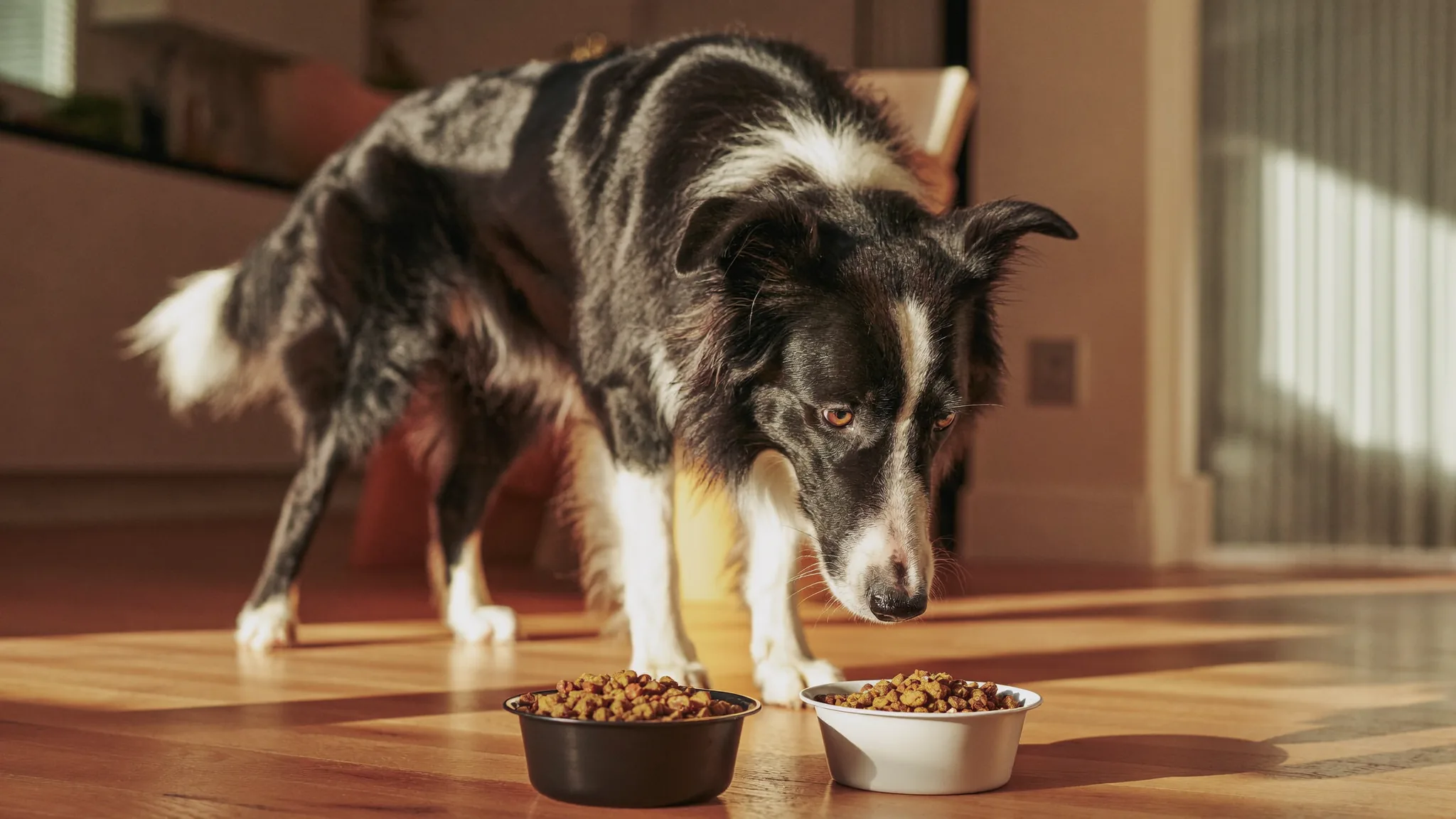

Your dog will not stop scratching. Their ears flare up again and again. Or their stools stay loose for weeks, no matter what you try. You have been to the vet, nothing serious showed up, but something clearly is not right.
In many of these cases the cause can lie in the food. A food reaction is one possible explanation, alongside environmental allergy, parasites or skin infections. Because these causes can look the same, your vet is the right first step: they can rule out other causes and decide whether an elimination diet makes sense. (Verlinden, 2006; Zur et al., 2002)
This article explains what hypoallergenic dog food actually is, how to tell whether your dog needs it, and which recipe is the right fit for their situation. Read it as background to a process with your vet, not as a diagnosis.
What is a food allergy in dogs?
A food allergy develops when your dog's immune system identifies a protein in their food as a threat, most commonly chicken, beef, or wheat. The reaction typically shows up in the skin, the digestive system, or both.
It helps to distinguish two things that often get confused:
- Food allergy: an immune response to a specific ingredient, even tiny amounts trigger a reaction.
- Food intolerance: a digestive issue without immune involvement, such as difficulty processing high-fat meals.
Both can produce similar symptoms, but they call for different approaches. The most common dietary allergens in dogs are chicken, beef, wheat, soy, dairy, and eggs, exactly the proteins found in most standard dog foods.

How do you spot a food allergy in your dog?
The most telling signs are persistent itching, recurring ear infections, and unreliable digestion, symptoms that keep coming back and do not respond well to standard treatment alone.
Does your dog show two or more of these?
- Ongoing itching around the paws, ears, belly, or groin
- Recurring ear infections (more than twice a year)
- Skin rashes, redness, or flaky patches
- Excessive paw licking
- Loose stools, diarrhoea, or irregular digestion
- Frequent bloating or a visibly distended belly
- Dull, dry, or rough coat
The two can look almost identical. A food allergy tends to be year-round; an environmental allergy (grass pollen, dust mites) follows the seasons. If you are unsure, a vet visit is the right next step.
How does hypoallergenic dog food work?
Hypoallergenic dog food replaces known allergens with ingredients your dog has never encountered. There are two genuine hypoallergenic approaches: a novel protein and a limited ingredient list.
Novel protein: the most direct approach for protein-driven allergies. You switch to a meat source your dog has never eaten before (venison, lamb, or salmon) so there is less chance of an existing sensitised response.
Limited ingredient: one protein, one carbohydrate. Fewer ingredients means fewer potential triggers and makes it easier to see what works.
Grain-free food is a separate category focused on the carbohydrate source, not the protein. It can overlap with a hypoallergenic approach (our range is grain-free and uses a novel protein), but grain-free alone is not a hypoallergenic strategy: a dog that reacts to chicken will still react to grain-free chicken food.
More background on hydrolyzed protein, single-protein recipes, and the elimination diet is in the knowledge bank.
🌿 Which recipe fits your dog?
Follow the steps based on your dog's situation.
Omega-3 from salmon supports the skin from within. Grain-free, novel protein for most dogs.
View productMild lamb protein, grain-free, single protein source. A strong first step for tummy trouble.
View productVenison is a truly novel protein for most dogs: minimal prior exposure, less chance of a primed immune response.
View product100% plant-based: removes all animal proteins completely. The most thorough option for broad sensitivity.
View product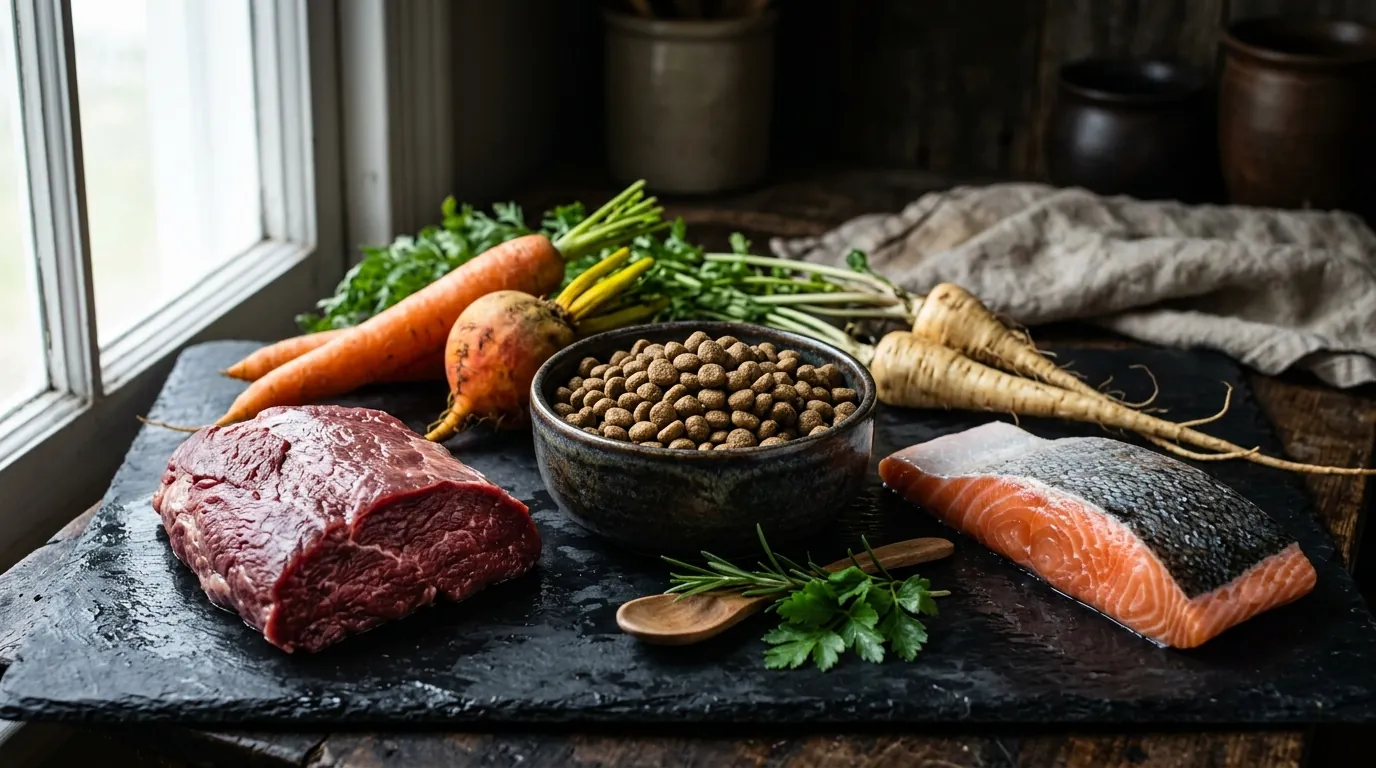
How to make the switch
Use a seven-day transition to reduce digestive upset. During this period, do not add other snacks or table scraps: any extra protein source disrupts the elimination process.
📅 Transition schedule
| Day | Previous food | New food |
|---|---|---|
| Days 1–2 | 75% | 25% |
| Days 3–4 | 50% | 50% |
| Days 5–6 | 25% | 75% |
| Day 7+ | — | 100% |
An elimination diet of at least 8 weeks is recommended to identify a cutaneous adverse food reaction in more than 90% of dogs and cats.
What the research shows: in dogs with a cutaneous adverse food reaction, roughly half showed clear improvement after about 3 weeks; from 5 weeks onward more than 80% achieved remission, and by 8 weeks more than 90%. (Olivry et al., 2015)
Note that this concerns diagnosis under supervision, with a re-challenge (provocation) to confirm the reaction. Do not keep switching endlessly on your own: discuss progress with your vet. In the meantime, keep a simple log so you have an honest picture after eight weeks. (Olivry et al., 2015)
Our hypoallergenic range
These recipes each use a different protein source and are grain-free. Which one fits depends on what your dog has already eaten; discuss that with your vet. Always check the current composition on the product page or packaging.
Venison & Potato
Gluten-free recipe with venison, rice, and potato. Ideal if your dog has eaten chicken, beef, or lamb before.
View productLamb & Potato
Mild, grain-free, limited ingredient list. A common starting point.
View productExplore our hypoallergenic range
All recipes with a novel protein, grain-free, without chicken or beef. See the full overview.
View hypoallergenic dog foodFrequently asked questions
Is grain-free dog food the same as hypoallergenic?+−
How long before I see results?+−
Which hypoallergenic food is the best starting point?+−
Do I need to see a vet first?+−
Questions about which recipe fits your dog? Email support@balloxx.com. We are happy to help.
Sources:
- Verlinden et al. (2006): Food Allergy in Dogs and Cats: A Review. Critical Reviews in Food Science and Nutrition.
- Olivry, T., Mueller, R.S. & Prélaud, P. (2015): Critically appraised topic on adverse food reactions of companion animals (1): duration of elimination diets. BMC Veterinary Research 11:225. Used for the 8-week term: in dogs, more than 80% achieved remission by ~5 weeks and more than 90% by 8 weeks; diagnosis is confirmed with a provocation.
Note: the previously cited Olivry reference from Veterinary Dermatology (2015) was replaced by the BMC Veterinary Research publication above, because the checked DOI pointed to a different article.
- Zur et al. (2002): Canine atopic dermatitis and adverse food reactions. Journal of Small Animal Practice.