Your puppy eats as if he has never been fed. One week the portion still fits; the next he seems hungry again. And everything you read says something different: three meals a day, two meals a day, keep him on puppy food until six months, until twelve months.
The confusion is understandable, because the honest answer is: it depends on his age, his size and how fast he is growing. This article sets out exactly how much puppy food to give, how often, and when to move him onto adult food.
Why puppy food is not a smaller portion of adult food
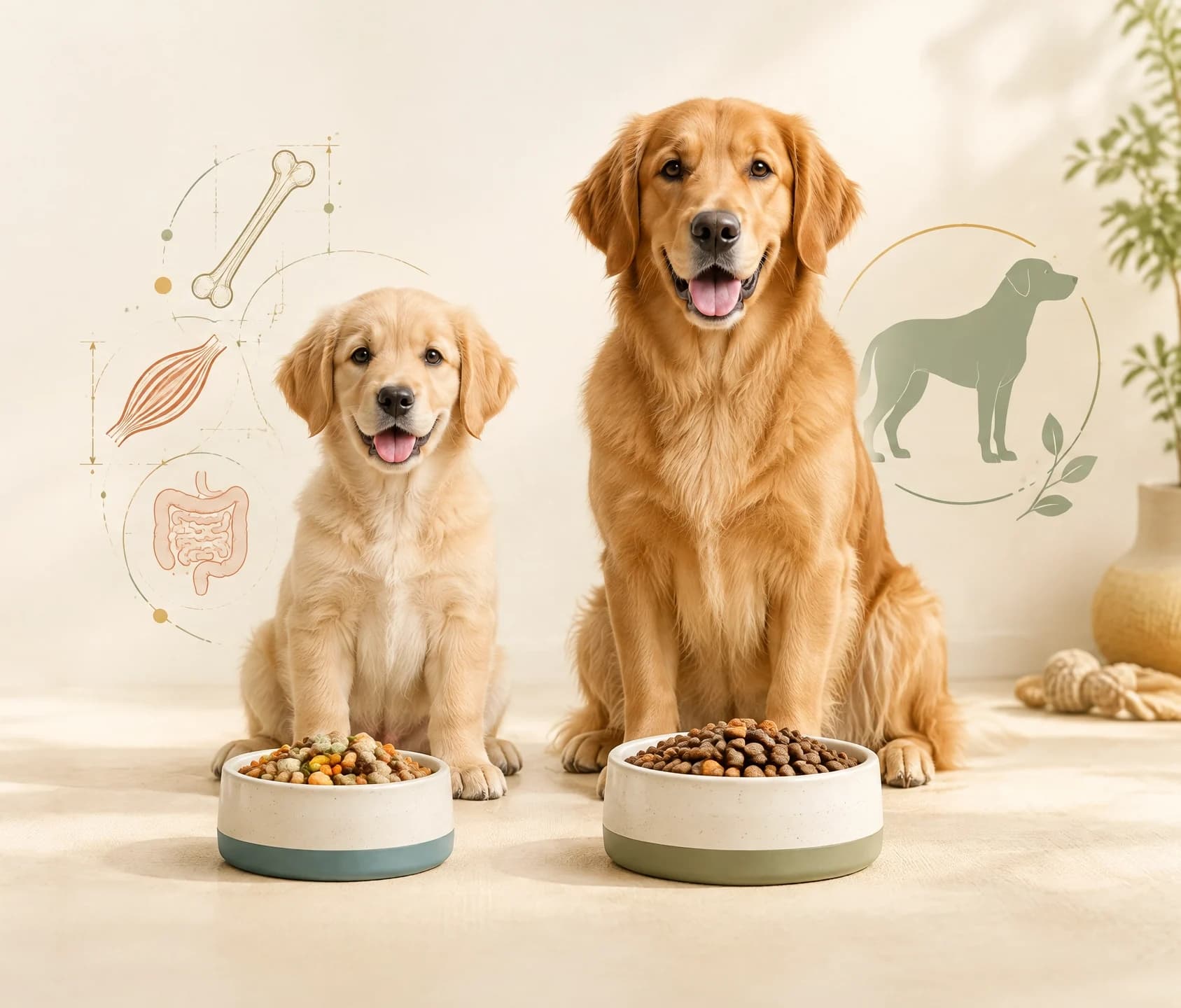
Puppy food is a complete diet formulated for the growth phase: more energy and building blocks per kilogram of body weight than maintenance food, with a mineral balance suited to a skeleton that is still developing.
A puppy is building bone, muscle and organs all at the same time. That is why the requirement per kilogram of body weight is higher than for an adult dog. According to Royal Canin Academy, puppies up to around four months of age need roughly twice as much energy per kilogram of body weight as an adult dog of the same breed. [1] WALTHAM likewise notes that a growing puppy's nutritional needs are demonstrably different from an adult dog's. [2]
The difference is not only in quantity but in balance: too little of a nutrient causes deficiencies, and too much can be just as harmful. That is exactly why you should not simply put a puppy on adult food. [2]
Want to know why the calcium-to-phosphorus ratio matters so much here? Our knowledge bank explains calcium and phosphorus in puppies separately.
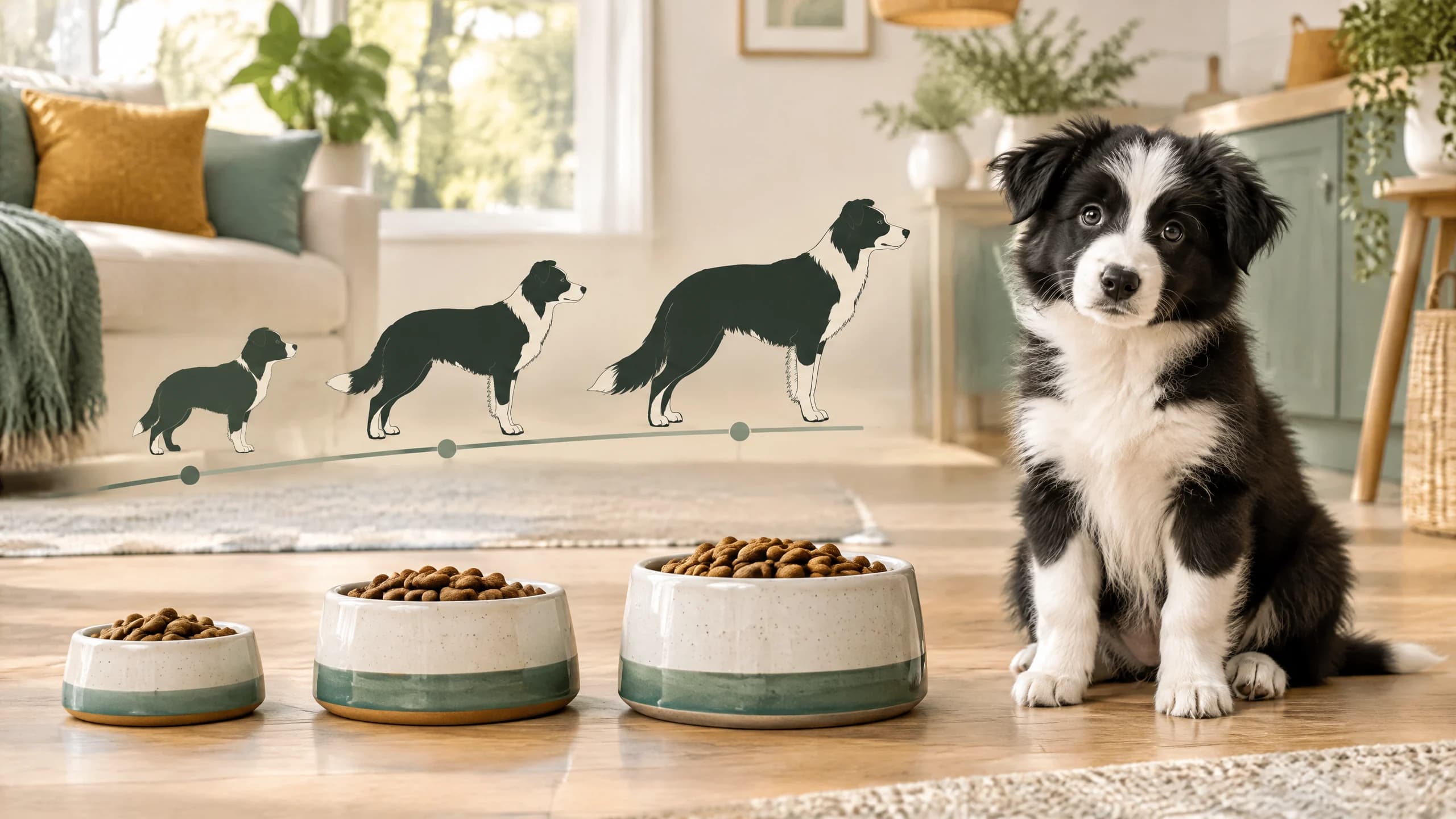
How much puppy food per day?
Always start with the feeding table for the recipe you are feeding: it is the only table drawn up specifically for that food. [3] Then use the weight that matches your puppy's age, not the weight you hope he will reach.
Our own guidelines per recipe look like this (grams per day, split across three meals):
| Puppy weight | Puppy Formula | Puppy Formula Extra | Puppy Large Breed |
|---|---|---|---|
| 2 kg | 90 g | 100 g | |
| 5 kg | 175 g | 190 g | 165 g |
| 10 kg | 285 g | 305 g | 270 g |
| 15 kg | 365 g | 390 g | 355 g |
| 20 kg | 430 g | 460 g | 425 g |
| 25 kg | 485 g | 520 g | 485 g |
| 30 kg | 540 g |
These are internal reference values. The table on the packaging or product page remains authoritative: recipes can change. [3]
In practice:
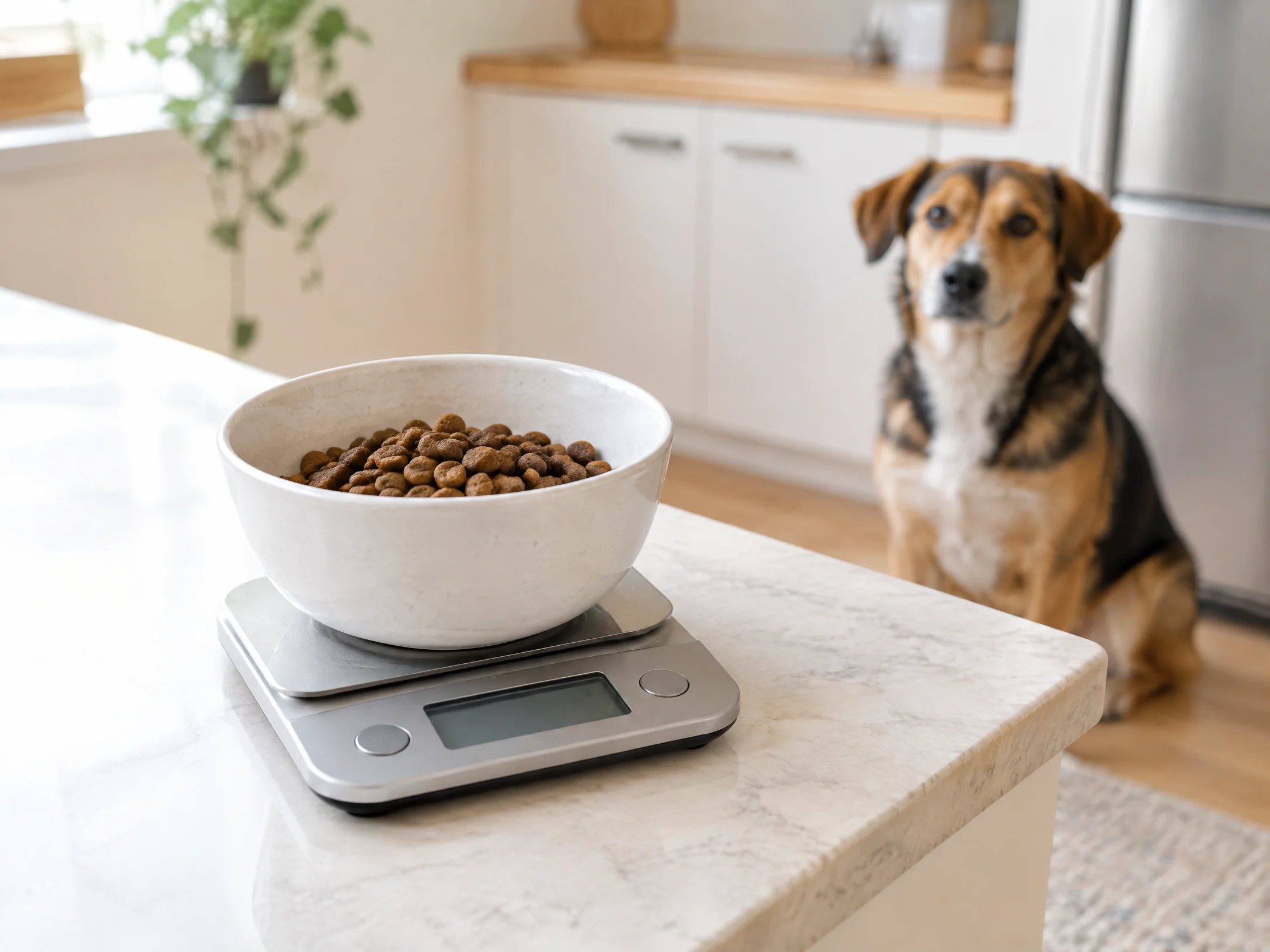
- Weigh your puppy. Ideally monthly until around six months, then every three months. [1]
- Keep him in a healthy, lean condition. Several sources stress that an overweight puppy is not a healthy puppy; aim for even growth rather than maximum growth. [1][4]
- Count everything. Training treats, rewards and snacks belong in the daily total. [1]
- Adjust to what you see, not to a fixed formula. Energy needs differ between individuals, even within the same litter. [4][5]
Do not add calcium, vitamins or minerals to a complete puppy food unless your vet advises it. Extra supplements are unnecessary and can be harmful. [1][4][6]
How often should a puppy eat?
The feeding schedule shifts as your puppy grows. WALTHAM lays out this progression: [2]
- 8 weeks to 4 months: around four meals a day, spread through the day, with the first meal early in the morning.
- From about 10 weeks: gradually reduce to three meals a day.
- From about 4 to 6 months: two meals a day. The Purina Institute also considers two meals appropriate around six months. [5]
Fixed mealtimes also help with house-training, because puppies often need to toilet shortly after eating. [5]
When do you switch to adult food?
The turning point is skeletal maturity: the point at which your dog has finished growing. That moment varies widely with breed size.
Royal Canin Academy uses these ages for the end of the growth phase: [1]
| Size | Growth phase over at roughly |
|---|---|
| Small | 8–12 months |
| Medium | 12–18 months |
| Large / giant | 18–24 months |
WALTHAM agrees: small breeds are adult at around one year, while large and giant breeds are not fully grown until around 18 to 24 months. [2] A review article on feeding large-breed dogs gives the same bands: small breeds around 10–12 months, large breeds 15–18 months, giant breeds up to 24 months. [6]
Switching too early can withhold nutrients and energy from a growing puppy; switching too late can lead to overfeeding and weight gain. [1] Unsure about the right moment for your dog? Ask your vet, who knows the breed, the growth pattern and the condition.
Is your puppy growing unevenly, does he have trouble with his legs, or are you unsure about his weight and condition? Have that assessed by your vet. Nutrition is one factor in healthy growth, not the only one. [1][4]
Which Balloxx puppy recipe suits your puppy?
Balloxx makes several puppy recipes, matched to size and preference:
🐕 Puppy Formula
A complete recipe for a puppy's growth phase, with a feeding table by weight. [3]
🐕 Puppy Formula Extra
A richer variant within the puppy range, also with its own feeding table. [3]
🦴 Puppy Large Breed
For puppies of large breeds, with its own mineral balance and a feeding table that runs to high weights. [3][7]
🌾 Puppy Grain-Free Chicken & Potatoes and Puppy Grain-Free Salmon & Potatoes
Grain-free puppy recipes, for anyone deliberately choosing a grain-free formulation. Wondering whether grain-free is necessary at all? Start with when grain-free makes sense. [3]
Once your puppy has left the growth phase behind, look at Junior or an adult recipe that suits his size.
Just switched to a new food? Follow the 7-day transition schedule: an abrupt change can upset the gut. [8]
Frequently asked questions about puppy food
How much puppy food should I feed per day?+
How often should a puppy eat?+
When can my puppy switch to adult food?+
The right start for your puppy
Browse the full puppy range with a feeding table for every recipe, or use the Food Choice Helper for personal advice.
View puppy foodSources:
[1] Royal Canin Academy: Optimal puppy growth for a healthy start in life. Skeletal maturity by breed size (small 8–12 months, medium 12–18, large/giant 18–24); puppies up to ~4 months need ~2× the energy per kilogram of an adult dog; risks of switching too early and too late; weighing frequency; no calcium supplementation.
[2] WALTHAM: Pocket book of puppy nutrition and care. A growing puppy's nutritional needs differ from an adult dog's; small breeds adult at ~1 year, large/giant at 18–24 months; feeding frequency 4→3→2 meals a day by age.
[3] Internal feeding guidelines from lib/feeding-guidelines.ts (Puppy Formula, Puppy Formula Extra, Puppy Large Breed, Puppy Grain-Free Chicken & Potatoes, Puppy Grain-Free Salmon & Potatoes; 3 meals a day). Product page and packaging remain authoritative.
[4] Purina Institute: Feeding large and giant breed puppies. Portion-controlled feeding; keep puppies lean; needs differ per individual; count snacks; two meals a day by around 6 months; no supplements unless the vet advises them.
[5] Purina Institute, additionally: fixed mealtimes support house-training; puppies should eat within roughly 30 minutes.
[6] Kępińska-Pacelik, J. & Biel, W.: Nutritional problems of large and giant breed dogs. Part I. Puppies. Transition to adult food: small breeds 10–12 months, large 15–18, giant up to 24 months; no additional vitamin/mineral supplements unless the vet advises otherwise.
[7] Knowledge bank: Calcium & phosphorus in puppies. Why the Ca:P balance differs by breed size and why extra calcium is counterproductive in large breeds.