You have found a better food for your dog. The new bag is ready to go. And then you read it: switching can cause diarrhoea. Now you are hesitating.
That hesitation is fair, but the fix is simple. A bad switch almost always comes down to one thing: too fast. Do it gradually and most dogs barely notice. This article gives you the schedule that works, why it works, and exactly what to do if your dog's stomach turns anyway.
Why you shouldn't switch all at once
Your dog's gut holds a settled population of bacteria tuned to his current food. New food calls for a new balance, and that shift takes days, not hours.
Every dog food has its own ratio of protein, fat and fibre. The gut flora adapts precisely to it: the bacteria your dog has now are the ones that break down his current food best. Switch overnight and the gut receives a load of nutrients the resident bacteria can't process efficiently.
The result is predictable. Undigested material draws water into the large intestine, and that causes soft stools or diarrhoea. Sometimes vomiting or wind comes with it. It isn't an allergy, and it isn't a sign the new food is bad: it's purely a matter of timing.
Research shows just how fast that shift happens. In a longitudinal study of 12 healthy adult beagles, the faecal microbiota shifted within days of an abrupt food change; metabolites stabilised after about 2 days and the microbiota after about 6 days. [15]
Faecal microbial diversity and composition shifted markedly and stabilised within days of a dietary intervention: 2 days for metabolites, 6 days for the microbiota.
Mind the scope: this is one small study in beagles after an abrupt switch. It supports the idea that the gut flora needs days to adjust, but it does not prove that a 7-day schedule prevents problems in every dog. [15]
That window is exactly what a gradual switch bridges. By mixing in the new food step by step, you give the bacterial population time to grow with it, without the spike of undigested food that triggers diarrhoea. The 7-day transition guide in the knowledge bank explains why a gradual switch spares the gut flora.
The 7-day transition schedule
Every two days, replace a quarter of the old food with the new one, until your dog is fully on the new food after a week.
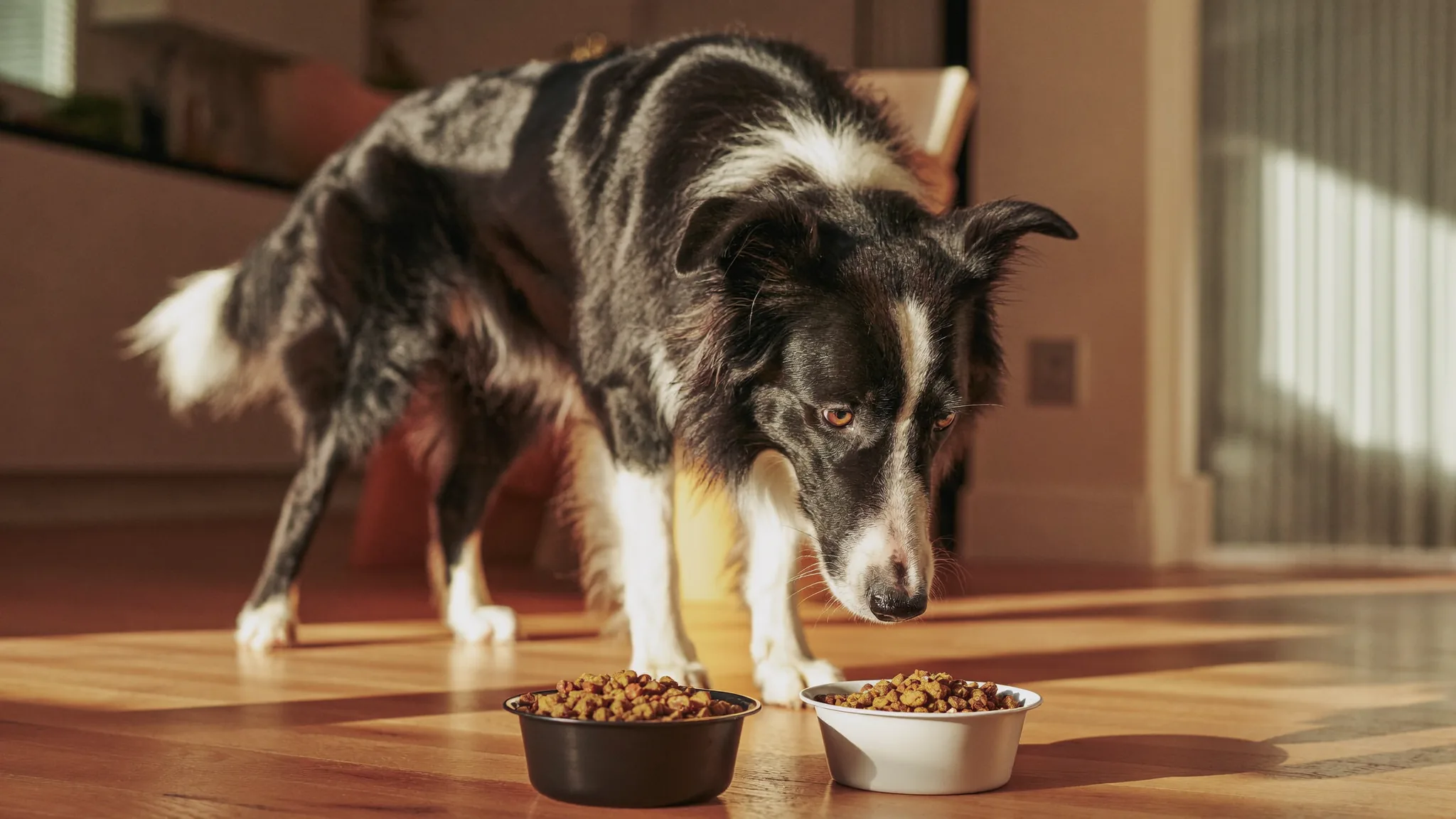
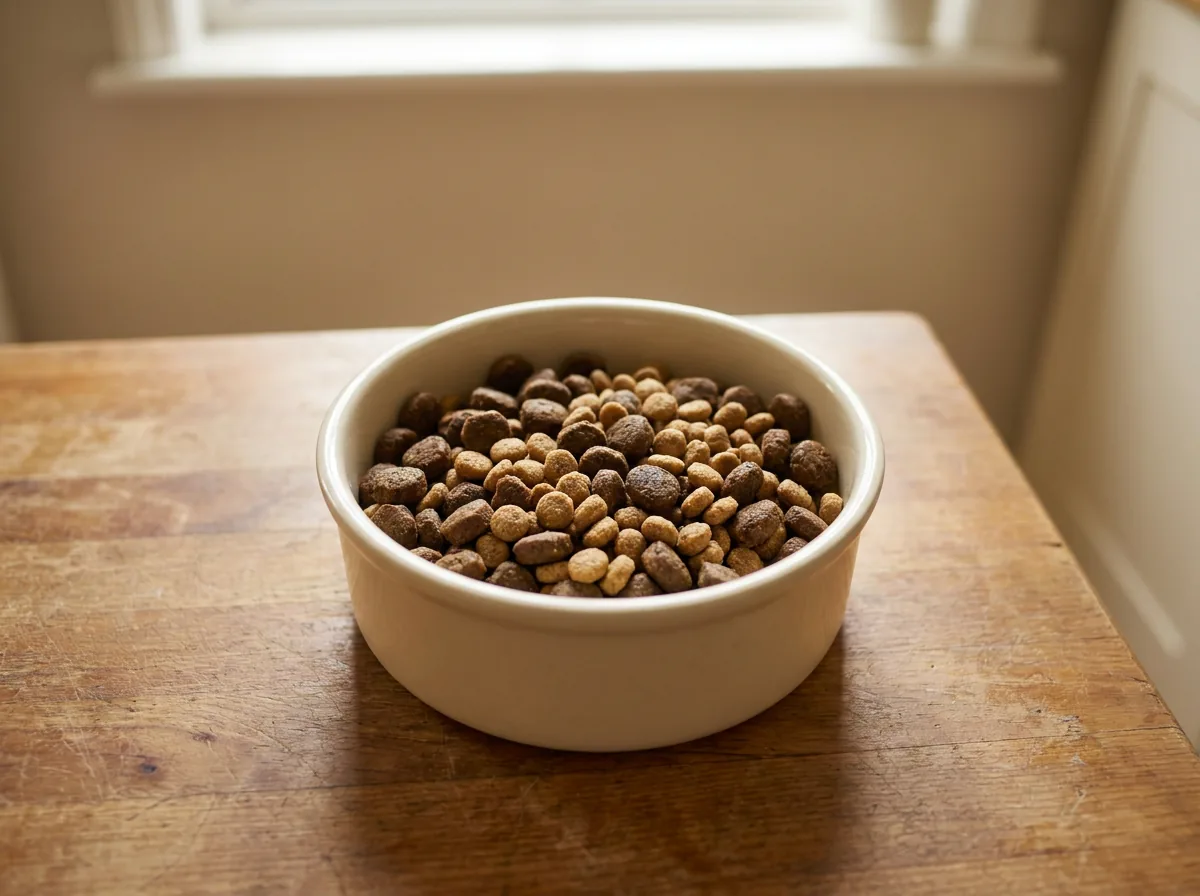
Mix the old and new food together in the same bowl: not side by side, and not old in the morning and new at night. A proper mix means the gut adjusts to the new recipe a little at every meal.
| Days | Old food | New food |
|---|---|---|
| Day 1–2 | 75% | 25% |
| Day 3–4 | 50% | 50% |
| Day 5–6 | 25% | 75% |
| Day 7 | 0% | 100% |
This schedule suits most healthy adult dogs. If your dog has a sensitive digestion, is a puppy or a senior, or has had trouble with a food change before, stretch it to ten to fourteen days and raise the share of new food in smaller steps. Slower is never wrong; too fast is.
Keep an eye on the stools all week. They're your main gauge: if they stay firm, move on to the next step. If they soften, hold at the same percentage for a day or two longer before continuing.
What to do if your dog gets diarrhoea anyway
Soft stools during a switch usually aren't a reason to stop, but they are a signal to slow down.
If your dog gets diarrhoea, step back one stage in the schedule and hold there for three to four days. Were you at 50/50 when it went wrong? Return to 75% old food and build up more slowly afterwards. In most cases the stools recover within a few days.
Two practical moves help. Split the daily portion into three or four smaller meals rather than two large ones: smaller amounts are easier to digest. And make sure fresh water is always available, because diarrhoea costs your dog fluids.
A common mistake is panicking halfway, switching back to the old food and trying a third food at the same time. That stacks three food changes on top of each other and gives the gut no rest at all. Choose one new food and give the switch time.
When to call the vet
Mild, short-lived gut upset is part of a switch. But some signs aren't, and then patience is the wrong call.
Call your vet if the diarrhoea lasts longer than 48 hours, if there's blood in the stools, or if your dog vomits repeatedly, turns lethargic or stops drinking. For puppies, seniors and dogs with a known condition that threshold is lower: they dehydrate faster. In those cases the food switch is no longer the real story, and a check-up is warranted.
Which food makes the switch easier?
The more digestible the new food, the smoother the switch. The quality of the recipe partly decides how your dog reacts.
Not every food is equally easy to introduce. Recipes with a clear, limited ingredient list and a highly digestible carbohydrate source such as rice give the gut less work than food full of shifting fillers. That's exactly what to look for when choosing your new food.
If you're switching because your dog has a sensitive digestion, Balloxx Sensitive with hydrolysed protein is built for precisely these dogs: the protein is broken into small, easily digestible particles. If you want a light everyday food, Lamb & Rice is a calm choice. Unsure between recipes? Browse our sensitive-stomach range for the full selection.
If your dog keeps having recurring diarrhoea, vomiting or a sensitive stomach, switching food is not automatically the answer. Have that assessed by your vet. [14]
Whatever your new food becomes: follow the schedule above, and the switch itself needn't be a worry.
Frequently asked questions about switching dog food
How long does it take to switch dog food?+
My dog has diarrhoea after switching: what now?+
Can I switch to new dog food all at once?+
Should I mix the old and new food or feed them separately?+
Not sure which recipe fits best? Write to us at support@balloxx.com. We're happy to help you personally.
Ready to switch?
Not sure yet which recipe suits your dog? We're happy to help. Browse the full range.
Browse the dog food rangeSources:
- Pilla, R. & Suchodolski, J.S. (2021): The Gut Microbiome of Dogs and Cats, and the Influence of Diet. Veterinary Clinics of North America: Small Animal Practice.
- Longitudinal fecal microbiome and metabolite data … after an abrupt dietary change in healthy adult dogs (2022): Animal Microbiome.
- Effect of yeast probiotic Saccharomyces cerevisiae on the gut health of dogs undergoing rapid dietary transition (2025): Frontiers in Veterinary Science.