
Reading a dog food label (whether on an online product page or on the back of a bag) can feel daunting with its technical terms, percentages, and ingredient tables. Pet food brands often highlight marketing buzzwords on the front, but true nutritional value is revealed only when reading the fine print on the back.
With this practical 4-step guide, you will easily demystify any pet food label and understand exactly what a recipe delivers for your dog.
Step 1: Complete Pet Food and the Correct Life Stage
The initial baseline check is simple but essential: is this food designed as a complete daily diet?
Complete pet food supplies all the essential amino acids, fats, vitamins, and minerals a dog needs daily to thrive. Complementary pet food (such as treats, meat sticks, and toppers) is intended only for rewards or snacks and should never exceed 10% of total daily caloric intake. [2]
Check the life stage immediately afterwards:
- Puppy & Junior: Rich in protein, calcium, and phosphorus to support controlled growth and skeletal development.
- Adult: Balanced energy and nutrient density tailored for maintenance in adult dogs.
- Senior & Light: Adjusted calorie profile with joint-supportive nutrients for older or less active dogs.
In 30 seconds
Four parts of the label
The same information sits on the product page. Food type first, then composition, analysis and amount.
On the labelComplete or complementary pet food
Your checkFor the daily bowl, you want complete pet food. Treats and complementary foods do not cover the day.
On the labelIngredients, always from most to least
Your checkLook at the protein source, the carbohydrates, and how specific the names are.
On the labelCrude protein, crude fat, crude fibre and crude ash
Your checkUseful when you compare two dry foods of the same type, not to pick a winner.
On the labelVitamins, minerals and feeding guideline
Your checkBefore you buy: does the amount fit your dog? At home, treat the table as a start.
In short: the full product information counts. One number or one line on the front is not enough.
Step 2: Decoding the Ingredients (Where Do the Calories Come From?)
The composition list shows the raw materials used to craft the recipe. Under the FEDIAF code of good labelling practice, which aligns with EU feed rules, feed materials are listed in descending order of weight at the time of use in the recipe: what appears first weighed the most at mixing. That is an ordering before processing, not the proportion in the finished product. [2][3]
Note that percentages are not always mandatory; they are when an ingredient is highlighted on the packaging. [3]
Because the list is by weight at mixing, a wet ingredient (such as fresh meat) can rank above a dried ingredient that actually contributes more dry matter to the finished kibble. Use the list as an entry point, not as proof that the first ingredient is also the largest share of the end product. [3]
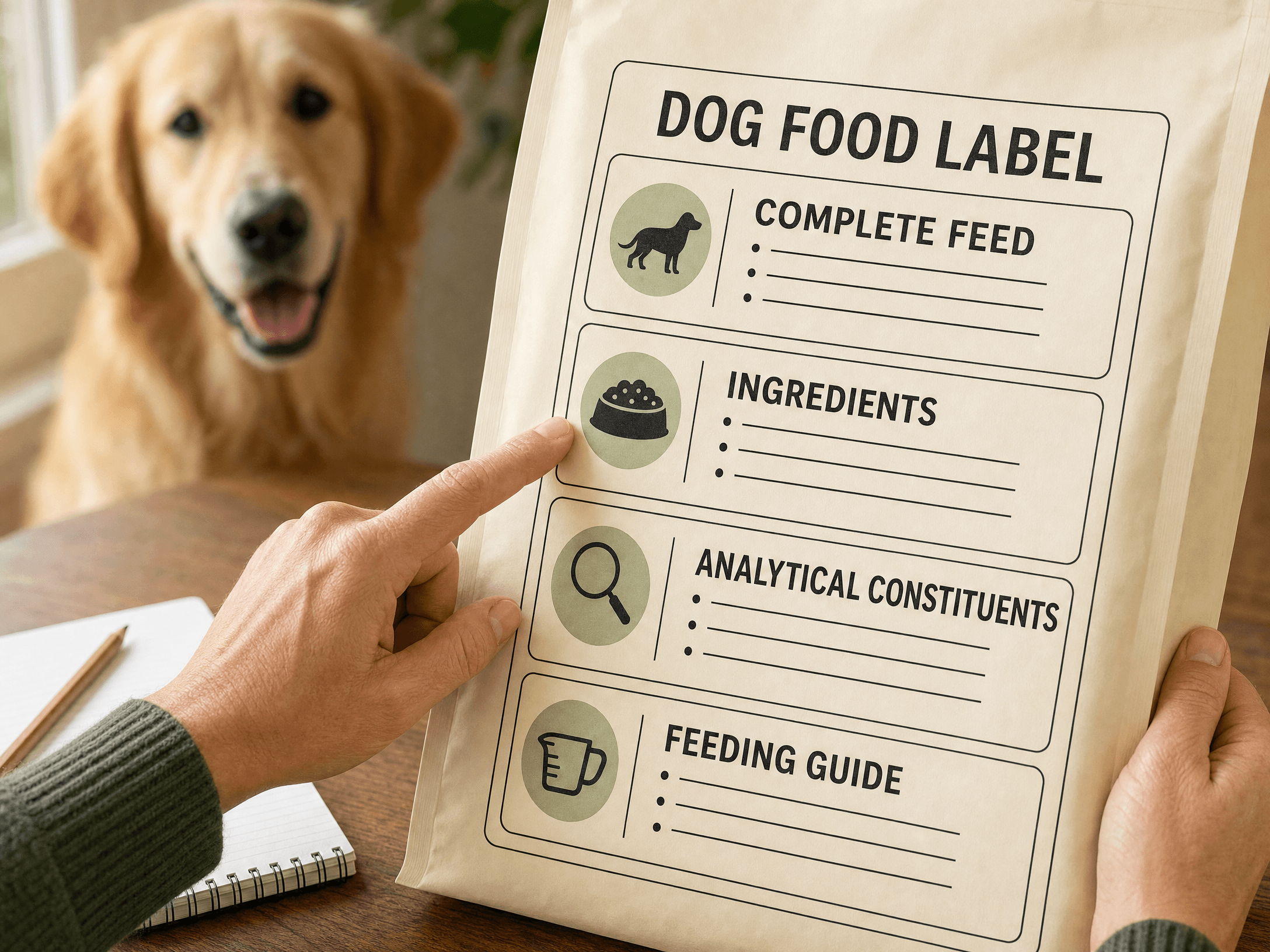
When reviewing the ingredient list, evaluate three core factors:
- Transparency (Open vs. Closed declaration): Does the brand declare precise ingredients such as "20% dehydrated chicken" (open declaration), or vague umbrella terms like "meat and animal derivatives" (closed declaration)? A specific name with a percentage tells you more than a category name. Transparency is a useful signal, but not proof of quality on its own: an open declaration says nothing about digestibility or how well the recipe suits your dog.
- Protein Quality: Clean, single animal proteins (such as chicken, lamb, salmon, or venison) offer superior bioavailability and amino acid profiles.
- Carbohydrate & Fiber Sources: Easily digestible rice, oats, potatoes, or peas deliver steady energy and support healthy digestive flora.
On the composition
What the names tell you
Not every word carries the same weight. Start with protein, carbohydrate, and how specific the name is.
MeaningThe protein source. Does that source suit your dog, or is it the one to avoid?
MeaningGrains as carbohydrate. Not a flaw on its own, but decisive if you want grain-free.
MeaningGrain-free carbohydrates. Peas also add plant protein.
MeaningFat and energy. Salmon oil points to omega-3 for skin and coat.
MeaningCategories, not a source. A named ingredient tells you more about what your dog eats.
Fresh Meat vs. Dehydrated Meat
A common point of confusion on pet food labels is the difference between fresh and dried meat ingredients:
- Fresh meat: Naturally contains approximately 70% water. During cooking and kibble extrusion, this moisture evaporates. An ingredient list with "fresh meat" at #1 often delivers a significantly smaller proportion of actual dry protein in the finished kibble.
- Dehydrated meat (meat meal): Has moisture removed before mixing. A percentage of 20% or 33% dehydrated meat represents a concentrated, dense dose of pure animal protein in the finished product.
Understanding this dynamic clarifies different recipe profiles:
- In Chicken & Rice, maize and wheat sit before dehydrated chicken (20%) and rice (20%). The chicken is therefore not the largest component by weight, but it is the named concentrated animal protein source.
- In Chicken & Potatoes, dehydrated chicken (33%) comes first, followed by peas and potato starch.
Always check these compositions on the current product page or packaging: recipes can change.
Curious whether a specialized recipe fits your dog? Explore our guides on grain-free dog food and hypoallergenic dog food.
Step 3: Understanding Analytical Constituents
The analytical constituents table outlines the guaranteed nutritional breakdown per 100 grams:
- Crude Protein (e.g. 22% – 32%): Essential building blocks for muscles, organs, skin, coat, and immune defense.
- Crude Fat (e.g. 10% – 20%): The primary energy fuel and source of fat-soluble vitamins and vital Omega fatty acids.
- Crude Fiber (e.g. 2% – 4%): Plant fibers that support healthy gut peristalsis and satiety.
- Crude Ash (e.g. 5% – 8%): This is not a filler or burnt residue, but the scientific laboratory measure for all essential minerals (including calcium, phosphorus, magnesium, and potassium) remaining after lab testing. What crude ash does and does not mean, and how to read ingredients on a label, is covered in the knowledge bank.
Never directly compare dry kibble percentages to canned wet food. Wet food consists of 75–80% moisture, making protein and fat percentages appear lower on the tin. Always calculate on a dry matter basis before comparing. [1]
Step 4: Applying Feeding Tables in Daily Practice
At the bottom of the packaging or product page sits the feeding chart, showing recommended daily portions in grams based on body weight.

Apply these recommendations in 3 practical steps:
- Target ideal weight: Calculate the daily ration based on your dog's ideal target weight, not their current weight if they are overweight.
- Use a kitchen scale: Measuring cups are imprecise; weighing accurately helps you stay consistent in what you give.
- Assess after 3 to 4 weeks: FEDIAF advises starting with the recommended amount and then following your dog's weight and body condition. Does the weight stay steady and can you feel the ribs under gentle pressure? Adjust the amount for changing activity or cold weather, and consult your vet if unsure. [2]
If gastrointestinal or skin issues persist, or if your dog requires a specific medical diet, always consult your veterinarian for an individual evaluation.
Three Real Examples from the Balloxx Range
From the range
Three recipes to run the same check before you choose
Three different situations, the same product information. Pick the example closest to your dog.
Adult dog · everyday
Chicken & Rice
A straightforward everyday food for adult dogs. A sensible start if your dog has no special needs.
Adult dog · grain-free
Chicken & Potatoes
Grain-free, with chicken, peas and potato starch. Useful if you want that choice on purpose, not as a general upgrade.
Adult dog · sensitive
Sensitive with hydrolysed protein
An option if your dog reacts sensitively; the protein is broken into smaller parts. Discuss this choice with your vet where possible.
Still unsure? The food selector asks about life stage, activity and what matters to you.
Start the food selectorFrequently Asked Questions
Does “complete pet food” mean I cannot feed anything else?+−
Is the most important ingredient always listed first?+−
Why does grain sometimes sit above chicken?+−
Do I need to read the feeding table before I buy?+−
What should I do if my dog needs a medical diet?+−
References & Scientific Sources
[2] FEDIAF. Understanding Pet Food Labels. European Pet Food Industry Federation.
[3] Dutch Pet Food Industry Association (NVG). Pet Food Labeling Guidelines.