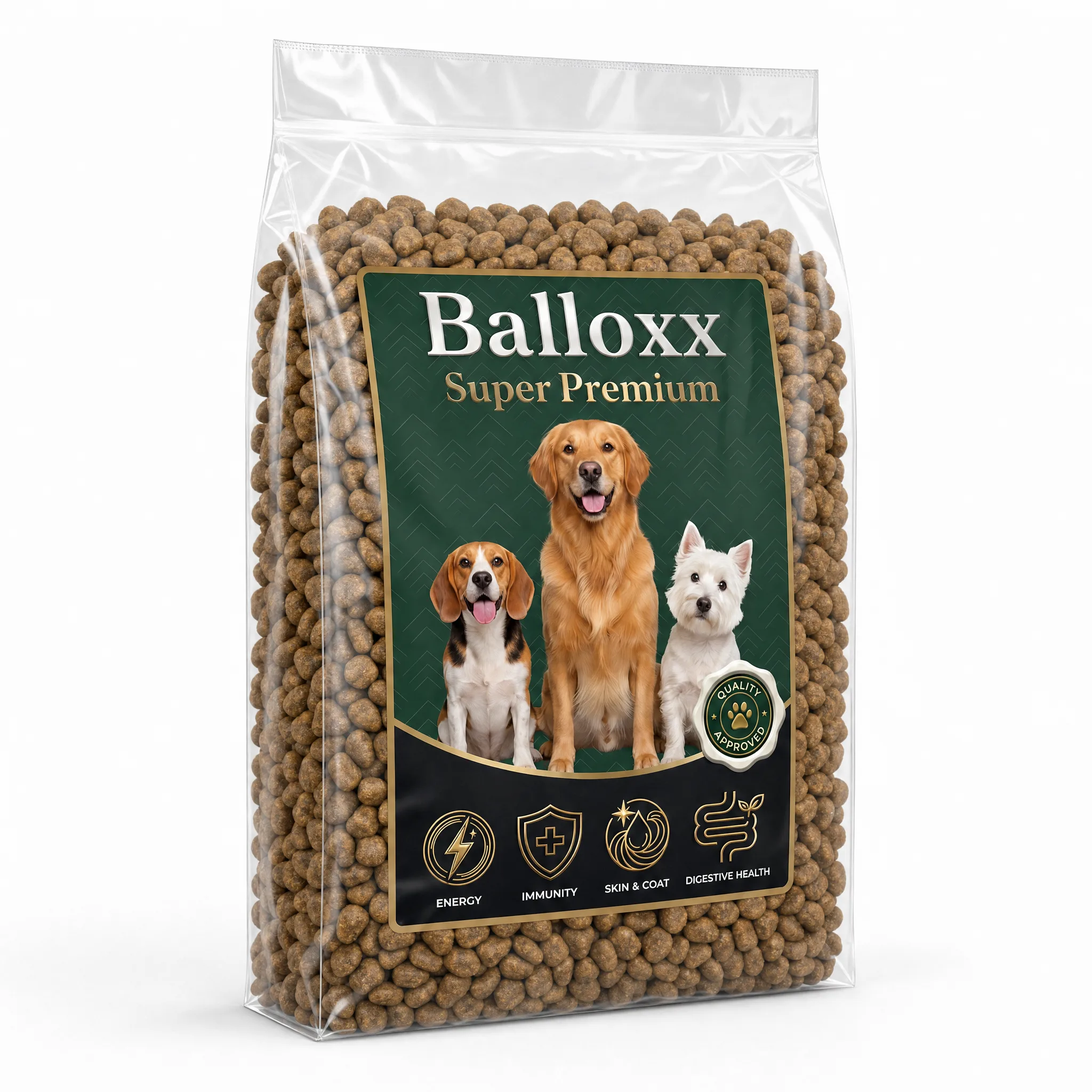
Small-Breed Kibble
Higher energy density and smaller kibble pieces, tailored to mini dogs up to about 10 kg.
What is it?
Small-breed kibble is formulated with higher energy density per gram and a smaller kibble size. It is meant for adult mini dogs (usually around 10 kg or lighter) who eat less volume in one bite than a medium-sized dog.
Why does it matter?
Small dogs have a relatively higher metabolism: they burn more energy per kilo of body weight. At the same time, standard kibble often does not fit their mouth well. Chewing becomes difficult, so your dog finishes the bowl faster without grinding properly.
How does it work?
More calories per gram means your mini dog meets its needs with a smaller portion, without overfilling the bowl. The compact kibble size fits a small mouth, so your dog chews calmly instead of swallowing kibble whole. Protein and fat levels are tuned for maintenance, not a puppy growth spurt.
Benefits
- Matches the higher metabolism of mini dogs
- Small kibble size that fits a small mouth
- Complete nutrition without overfeeding
Misconceptions
“Small kibble” is not automatically puppy food. Adult mini dogs need adult nutrition, just in the right size and energy density. Puppy Ca:P is not right for an adult toy poodle.
FAQs
Sources
- Burger I.H., Johnson J.V. (1991). Dogs large and small: the allometry of energy requirements within a single species.. Journal of Nutrition 121(suppl. 11):S18-S21. doi:10.1093/jn/121.suppl_11.S18 (PMID 1941223)
- Bermingham E.N., Thomas D.G., Cave N.J., Morris P.J., Butterwick R.F., German A.J. (2014). Energy requirements of adult dogs: a meta-analysis.. PLoS ONE 9(10):e109681. doi:10.1371/journal.pone.0109681 (PMID 25313818)
- Hennet P., Servet E., Soulard Y., Biourge V. (2007). Effect of pellet food size and polyphosphates in preventing calculus accumulation in dogs.. Journal of Veterinary Dentistry 24(4):236-239. doi:10.1177/089875640702400405 (PMID 18309857)
- Kepinska-Pacelik J., Biel W. (2023). Nutritional problems of large and giant breed dogs. Part I. Puppies.. Folia Pomeranae Universitatis Technologiae Stetinensis, Agricultura, Alimentaria, Piscaria et Zootechnica 366(65):36-46. doi:10.21005/aapz2023.65.1.4