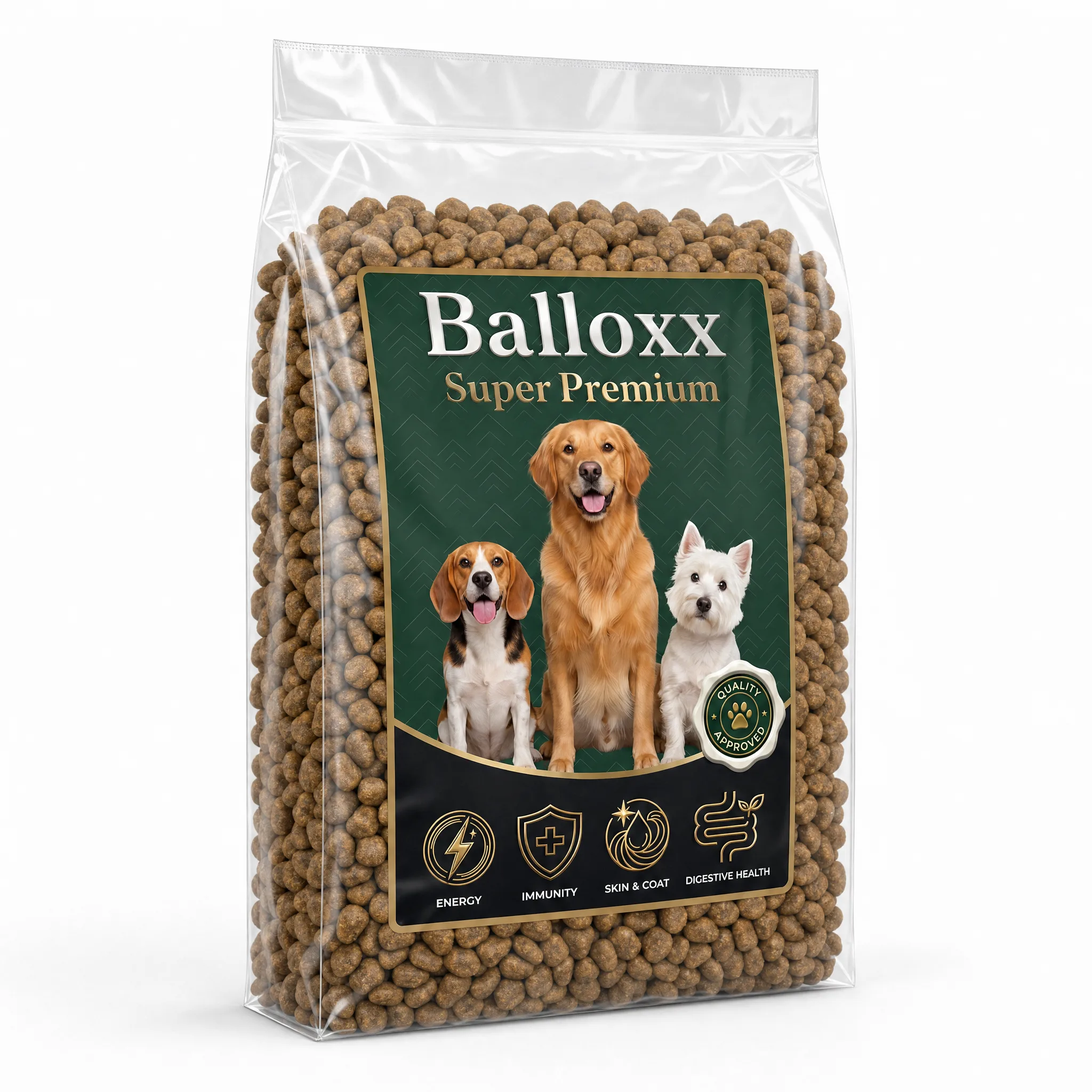
Senior: Kidneys & Joints
Moderated phosphorus and joint support for older dogs, everyday senior food, not a prescription renal diet.
What is it?
Senior dog food is tuned for a slower metabolism, joint load and the need for a gentler mineral balance. Balloxx senior formulas are everyday complete nutrition, not a prescription veterinary renal diet.
Why does it matter?
Older dogs move less and burn fewer calories. Excess weight adds joint strain. At the same time, joints wear after years of use; glucosamine and chondroitin support cartilage and joint fluid. For kidneys, phosphorus is the focus: a moderated level fits “kidney-friendly” everyday feeding, but does not replace treatment for diagnosed kidney disease.
How does it work?
Senior kibble combines slightly lower energy density with adjusted phosphorus versus adult. Glucosamine and chondroitin act as building blocks for joint tissue, supportive, not a painkiller. Protein stays adequate for muscle maintenance; extremely low protein is reserved for medical renal diets under veterinary supervision.
Benefits
- Moderated phosphorus for everyday kidney-friendly feeding
- Glucosamine & chondroitin for joint support
- Energy density matched to lower activity
Misconceptions
Senior food is not medicine for kidney failure. With raised kidney values, excessive drinking or vomiting, see a vet, possibly a prescription renal diet. Balloxx senior is preventive, everyday support for healthy ageing.
FAQs
Sources
- Ross S.J., Osborne C.A., Kirk C.A., Lowry S.R., Koehler L.A., Polzin D.J. et al. (2006). Clinical evaluation of dietary modification for treatment of spontaneous chronic kidney disease in cats.. Journal of the American Veterinary Medical Association 229(6):949-957. doi:10.2460/javma.229.6.949 (PMID 16978113)
- Jacob F., Polzin D.J., Osborne C.A., Allen T.A., Kirk C.A., Neaton J.D. et al. (2002). Clinical evaluation of dietary modification for treatment of spontaneous chronic renal failure in dogs.. Journal of the American Veterinary Medical Association 220(8):1163-1170. doi:10.2460/javma.2002.220.1163 (PMID 11990962)
- Elliott J., Rawlings J.M., Markwell P.J., Barber P.J. (2000). Survival of cats with naturally occurring chronic renal failure: effect of dietary management.. Journal of Small Animal Practice 41(6):235-242. doi:10.1111/j.1748-5827.2000.tb03932.x (PMID 10879400)
- Schauf S., Coltherd J.C., Atwal J., Gilham M., Carvell-Miller L.J., Renfrew H. et al. (2021). Clinical progression of cats with early-stage chronic kidney disease fed diets with varying protein and phosphorus contents and calcium to phosphorus ratios.. Journal of Veterinary Internal Medicine 35(6):2797-2811. doi:10.1111/jvim.16263 (PMID 34545958)
- Barbeau-Gregoire M., Otis C., Cournoyer A., Moreau M., Lussier B., Troncy E. (2022). A 2022 systematic review and meta-analysis of enriched therapeutic diets and nutraceuticals in canine and feline osteoarthritis.. International Journal of Molecular Sciences 23(18):10384. doi:10.3390/ijms231810384 (PMID 36142319)
- McCarthy G., O'Donovan J., Jones B., McAllister H., Seed M., Mooney C. (2007). Randomised double-blind, positive-controlled trial to assess the efficacy of glucosamine/chondroitin sulfate for the treatment of dogs with osteoarthritis.. The Veterinary Journal 174(1):54-61. doi:10.1016/j.tvjl.2006.02.015 (PMID 16647870)